
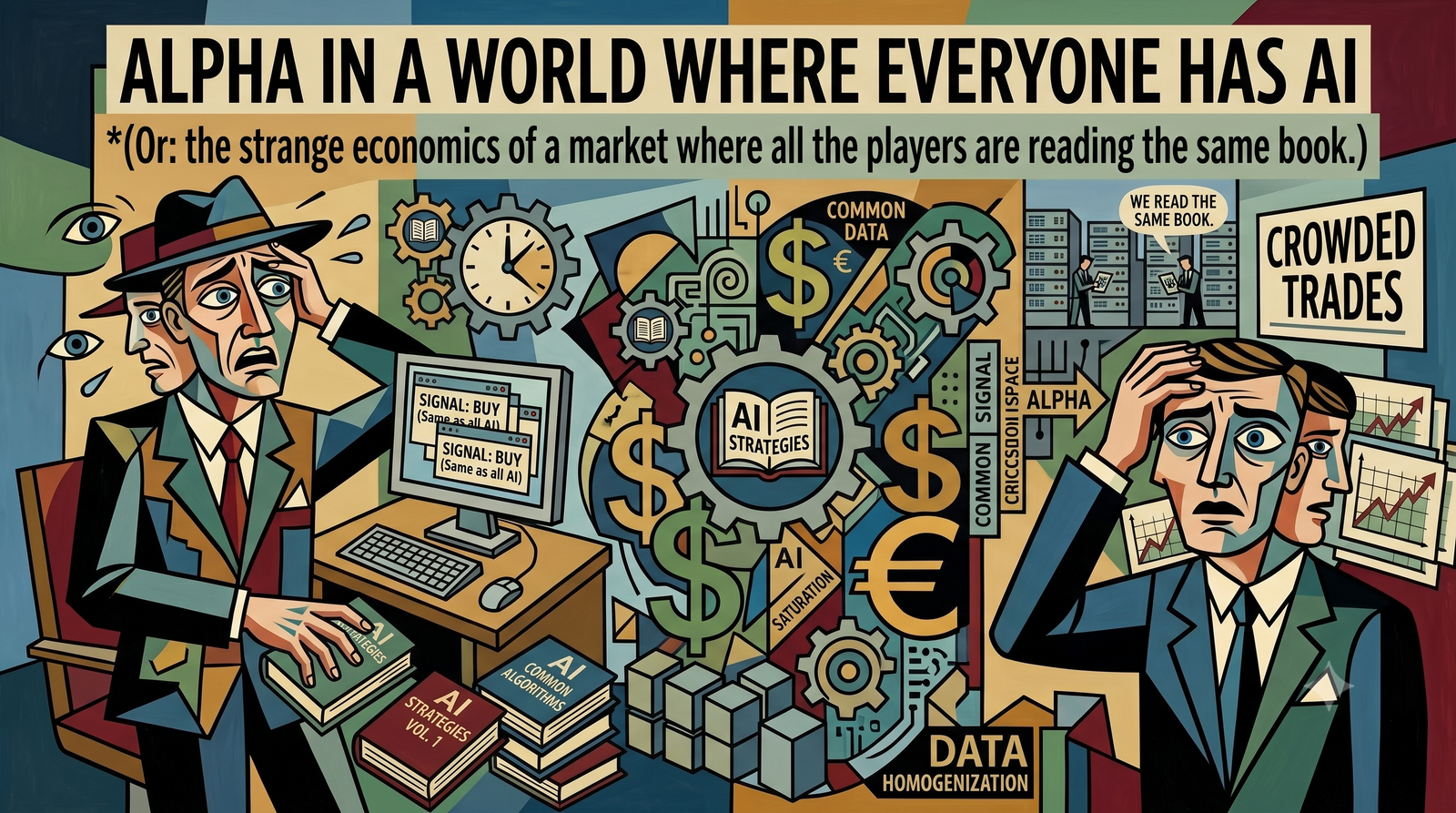
*(Or: the strange economics of a market where all the players are reading the same book.)*
TL;DR
Predicting equity prices is one of the hardest things anyone has ever pointed a neural network at. Markets are noisy, non-stationary, adversarial, and reflexive (meaning the act of predicting them changes them). AI is now, by most estimates, involved in roughly 89 percent of global trading volume, which means the future of stock prediction is largely a story of AI models trading against other AI models. And here is the deeper twist. As agentic AI becomes universal, the very advantage it was meant to confer erodes. When everyone has the same superpower, nobody does. The alpha eats itself. This is not a hypothesis. It is already happening.
Why predicting a stock is different from predicting the weather
You can predict the weather. Not perfectly, but usefully. A five-day forecast is now accurate enough to plan a wedding. The reason is that clouds, unlike people, do not react to being predicted.
Equity prices do. This is Soros's old point about reflexivity. Markets are made of participants who watch each other, react to each other, and update their beliefs based on the prices those beliefs produce. Prediction is not a passive act. Every good model, once it is used, moves the thing it was trying to model.
Layer on top of that a few structural facts. Financial markets are radically non-stationary. The statistical regularities that held in 2010 did not hold in 2016, did not hold in 2020, and will not hold in 2026. The signal-to-noise ratio is brutal; most of what looks like a pattern is noise. And the underlying process is adversarial. The participants are actively trying to fool each other.
The result is that, as the academic literature politely puts it, "no reputable model can beat the stock market" on any consistent basis. Renaissance's Medallion Fund is the famous exception, and its methodology is guarded like a state secret for precisely this reason.
The prediction gold rush is still on
None of that has stopped anyone (including myself) from trying. By most estimates, AI systems now handle roughly 89 percent of global trading volume. Algorithmic trading revenues topped $10.4 billion in 2024 and are projected to hit $16 billion by 2030. Every hedge fund with a pulse is building AI-driven prediction pipelines. Every retail broker is bolting AI advisers onto its app. Every LLM lab gets asked, at least once a week, whether it can predict tomorrow's close.
The pitch is intuitive. If AI can beat grandmasters at chess and Go, why not the market? The answer is that chess is stationary, well-defined, and non-reflexive. The market is none of those things.
When AI meets AI: the model-on-model market
The bigger shift, though, is what happens when you assemble hundreds of firms, billions of dollars, and thousands of AI models into the same order book.
You get a market where the counterparty on the other side of your trade is, increasingly, not a human. It is another model, trained on similar data, deployed with similar objectives, executed at similar speeds. The classical picture of price discovery, in which informed traders slowly nudge prices toward fundamentals, no longer describes what is happening. What is happening is closer to a very fast, very expensive game of poker between programs.
An NBER paper published in 2025 identified a genuinely unnerving property of this new market. AI trading algorithms can autonomously sustain what economists call "supra-competitive profits" without any explicit agreement, communication, or intent. In plain English, they can learn to collude without meaning to. Regulators have noticed. They have also noticed that antitrust law was written for humans, and does not currently know what to do about it.
The IMF's own assessment, published in late 2024, was diplomatically honest. AI, they concluded, is making markets both more efficient *and* more volatile. Which is not a contradiction. It is a description.
The alpha problem: it decays
Which brings us to the deepest structural problem. Alpha, in trading, is the edge (the excess return your strategy earns over a passive benchmark). Alpha is what everyone is looking for. And alpha decays.
It always has. The moment you publish a strategy, other traders copy it, and the profit disappears. But AI is compressing this timeline in ways the industry is still adjusting to. Recent research finds that the average alpha on new trades now decays in about twelve months. Some factors, particularly mechanical ones like momentum and mean-reversion, decay much faster.
Why? Because AI models trained on the same historical data, using similar architectures, tend to identify the same opportunities and pile into the same trades at almost the same time. What used to be private edge is now, effectively, public consensus with a lag. And the lag is shrinking.
This has a name in the literature. *Signal crowding.* It has an obvious consequence. When every model spots the same pattern, the pattern stops paying.
The equilibrium: everyone has AI, nobody has an edge
Now imagine the dynamic taken to its natural conclusion.
In a world where agentic AI is universal, where every hedge fund, every prop shop, every retail app, and every treasury desk is running frontier models optimising for the same objective, the market becomes something strange. Every participant has world-class prediction. Every participant is running against other participants with world-class prediction. The edge that AI once conferred vanishes, not because AI got worse, but because everyone else got better.
This is not a hypothetical. It is already the direction of travel. Academic work is now describing a phenomenon called *reflexive signal erosion*. The process by which AI-driven forecasting quietly destroys the very signals it was designed to trade on. The more sophisticated the models, the faster the erosion.
The end state of this, if it plays out, looks a lot like a very fast, very expensive version of the efficient market hypothesis. Not because Fama was right in 1970, but because we are building the machinery that finally makes him right around 2030.
Where might the edge still live?
Nothing about the above is a counsel of despair. There are still places where AI can find genuine, defensible edge in markets. They are, notably, the places where models cannot easily converge.
*Unique data.* If your model is training on data other models do not have (proprietary satellite feeds, private transaction data, first-party consumer signals), your edge does not crowd because nobody else has the same input.
*Judgment factors.* Recent research shows that judgment-based factors like value and quality decay much more slowly than mechanical factors like momentum. It turns out taste is harder to copy than a formula.
*Longer horizons.* Model-versus-model competition is fiercest at the fastest timescales. On longer horizons, structural factors and macroeconomic reasoning still matter. Not everything can be arbitraged away in twelve months.
*Human judgment on top.* The paradoxical conclusion, in a fully agentic market, is that the last remaining edge may be the one AI cannot replicate. Interpretation. Context. Knowing when the models are all wrong at the same time.
Closing
Predicting equity prices with AI is difficult because the market is non-stationary, reflexive, and adversarial. It gets harder, not easier, as AI becomes more capable, because the counterparty gets more capable at the same rate. And the endgame of universal agentic AI in markets is not a world of super-forecasters. It is a world where the collective forecast is very good, but nobody's individual edge is durable.
The market is quietly becoming a mirror. Every model is trading against a mildly different version of itself. In that world, the edge is not in having AI. It is in having something the other AIs do not.
*Nothing in this piece is investment advice. It is, at best, a rueful description of a game that is quietly becoming harder for everyone playing it.*
---
Sources
- [Artificial intelligence in financial market prediction: advancements in machine learning for stock price forecasting, Frontiers](https://www.frontiersin.org/journals/artificial-intelligence/articles/10.3389/frai.2025.1696423/full)- [Machine learning, stock market forecasting, and market efficiency, Springer](https://link.springer.com/article/10.1007/s41060-025-00854-4)- [AI-Powered Trading, Algorithmic Collusion, and Price Efficiency, NBER](https://www.nber.org/papers/w34054)- [Artificial Intelligence Can Make Markets More Efficient and More Volatile, IMF](https://www.imf.org/en/blogs/articles/2024/10/15/artificial-intelligence-can-make-markets-more-efficient-and-more-volatile)- [Overcrowded AI Trading Killed the 6% Edge, Traders Agency](https://tradersagency.com/blog/overcrowded-ai-trading-strategies-erased-investor-edge)- [Not All Factors Crowd Equally: Modeling, Measuring, and Trading on Alpha Decay, arXiv](https://arxiv.org/pdf/2512.11913)- [AI-Driven Alpha Decay: Algorithmic Homogenization, Reflexive Signal Erosion, and the Paradox of Intelligent Markets, arXiv](https://arxiv.org/html/2605.23905v1)- [The Rise Of Algorithmic Trading: How AI Is Reshaping Financial Markets, Forbes](https://www.forbes.com/sites/delltechnologies/2025/12/02/the-rise-of-algorithmic-trading-how-ai-is-reshaping-financial-markets/)