
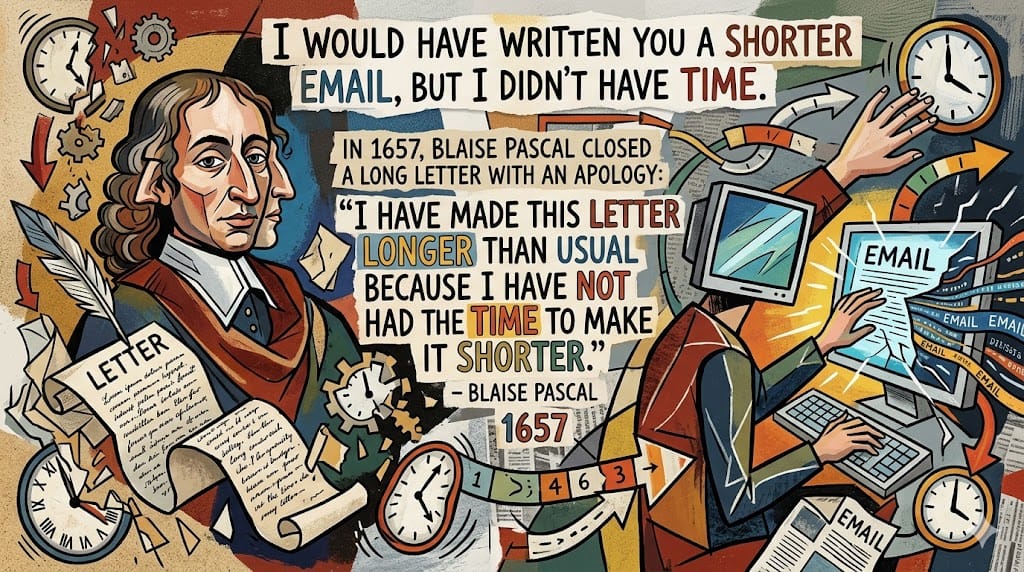
In 1657, Blaise Pascal closed a long letter with an apology: "I have made this letter longer than usual because I have not had the time to make it shorter." Today you'll see it credited to Twain, Franklin, Cicero, Goethe, and Churchill, depending on which meme you read. It's Pascal's. He almost never gets it back.
The line endures because it captures the one thing about writing nobody wants to admit. Short is harder than long.
First drafts sprawl because we haven't yet decided what we mean. The work of brevity is the work of deciding: which sentences earn their place, which paragraphs are scaffolding, which words are filler. Eighty percent of any first draft is the writer thinking out loud. Cutting it requires knowing what we actually meant, which is the bit that takes the time Pascal didn't have.
This used to be a niche concern. It isn't anymore. Modern AI will produce 4,000 words on any subject in 12 seconds, at the cost of a button click. The natural friction that kept writing roughly proportional to thought has dissolved. Output has decoupled from intention.
Which means long writing is about to be functionally infinite. The opposite skill, the Pascal skill, the second draft, the cut, has become roughly infinite in value too. The next decade will be kind to anyone who can take 4,000 AI-generated words and turn them into the 400 that meant something. Less kind to people who hit send on the 4,000.
So: write the long version first. Then ask the Pascal question of every paragraph, sentence, and word. What is this for? If you can't answer in one line, cut it.
And when you can't make it shorter, do what Pascal did. Apologise. It is the least you can do for the reader who's about to pay your time-debt for you.