
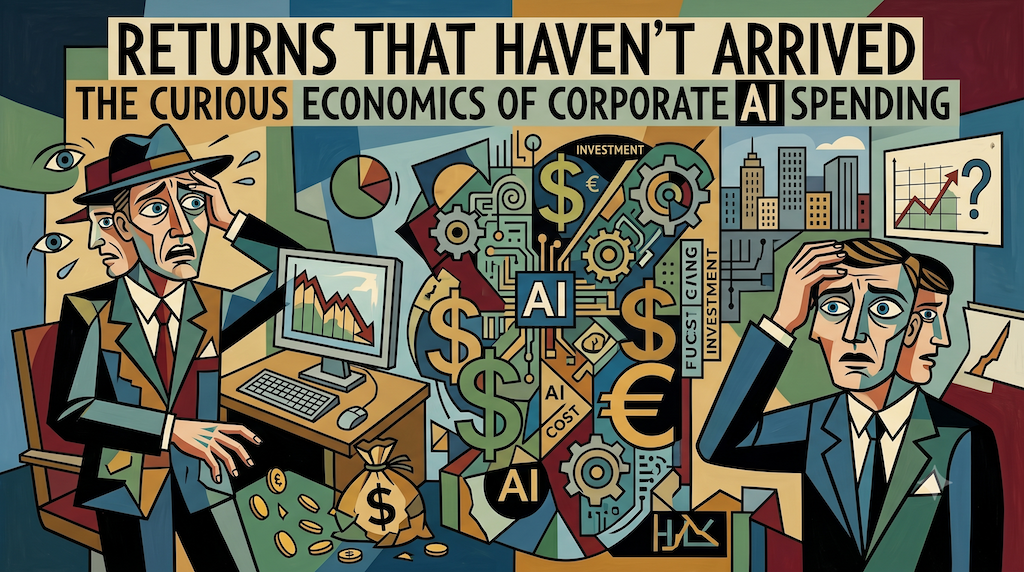
(Or: how to spend $40 billion on a promise.)
TL;DR
Corporate AI spending is doing something strange right now. By the most recent estimates, large companies have collectively poured $30 to $40 billion into generative AI. And by an increasingly long list of independent measures (MIT, McKinsey, IBM, Gartner, Bain), the returns are, charitably, not yet arriving at the scale the boardroom slides predicted. Yet AI budgets aren't contracting. They're sharply expanding. 83 percent of large companies plan to increase enterprise-wide AI spending by more than 15 percent over the next two years. They are, in effect, financing the next two years of AI investment on the basis of returns that haven't yet shown up. They aren't wrong, exactly. They're operating on faith. And the most interesting part is why.
The strangest spending curve in tech
Most categories of corporate spending follow a vaguely intuitive pattern. Returns come in, spending goes up. Returns don't come in, spending goes down. AI is, at the moment, doing neither of those.
Companies are reporting that AI is not yet delivering the cost savings projected in the original business cases. They are also, simultaneously, raising their AI budgets faster than almost any other line item on the P&L. If you sketched that on a graph you would, reasonably, double-check the data. The data is fine. The behaviour is the unusual part.
What the receipts look like
Almost every credible piece of independent research from the last twelve months tells a version of the same story.
MIT's NANDA initiative published The GenAI Divide in August 2025, drawing on 150 executive interviews, 350 employee surveys, and 300 public AI deployments. The headline number was 95 percent. As in, 95 percent of enterprise generative AI pilots fail to deliver any measurable P&L impact. Across the survey base, around $30 to $40 billion in generative AI spend has produced real value in roughly 5 percent of projects.
McKinsey's most recent research is, in its own polite way, even bleaker. Nearly eight in ten companies report using GenAI. About the same proportion report no significant bottom-line impact from it. Fewer than 30 percent have a CEO directly sponsoring the AI agenda, which suggests at least part of the gap is a leadership problem dressed up as a technology problem.
IBM's CEO Study reports that just 25 percent of AI initiatives delivered the ROI executives expected, and only 16 percent have actually scaled enterprise-wide. Gartner's April 2026 data is more nuanced but pulls in the same direction. Roughly 28 percent of AI use cases fully meet ROI expectations. About 20 percent fail outright. Of the failures Gartner investigated, 57 percent of leaders said the project failed because the organisation "expected too much, too fast." Gartner also predicts that 60 percent of AI projects lacking AI-ready data will be quietly abandoned through 2026.
Bain's latest global survey of large companies adds a particularly diplomatic line to the chorus. Cost savings from AI are, in its own framing, "broadly falling short of projections," and the missed targets "should be making executives uncomfortable." In strategy-consulting register, that is roughly the equivalent of an air-traffic controller mentioning, in passing, that they are observing some inbound terrain.
These are not small numbers. And they all roughly agree.
And yet, more money
Here is the strange bit. Despite all of the above, AI budgets are still going up. Sharply.
83 percent of large companies plan to increase enterprise-wide AI spending by more than 15 percent over the next two years. 42 percent of CFOs intend to raise their own AI budgets by 30 percent or more. Almost every Fortune 500 is now tracking AI usage in some form. Hiring continues. Vendor contracts continue. The entire spending curve is shaped like a company being told its supplier is unreliable and responding by ordering twice as much.
Why?
Because the gap is real, just not where most companies are standing
Look closely at the data and one finding cuts through the noise.
Among CFOs deploying AI at scale, over 40 percent are highly satisfied with the results. Among CFOs still at the pilot stage, only 25 percent are. IBM's data tells the same story from a different angle: 16 percent of organisations have scaled AI enterprise-wide, and those are disproportionately the ones reporting real returns. The 5 percent of projects MIT identified as creating real value were also, overwhelmingly, post-pilot deployments.
In other words: the value isn't fake. It's just concentrated in places most companies haven't reached yet. The companies that have done the hard, unglamorous, organisation-wide work (the integrations, the retraining, the workflow redesign, the data plumbing) are seeing the returns the rest are still projecting. The gap between scaled and not-scaled is widening. And every CFO can see it widening. Which is why nobody wants to be on the wrong side of it, even if it means writing a budget today against receipts they haven't personally collected.
The not-quite-dot-com parallel
It's tempting to call this 1999 all over again. It mostly isn't. In 1999, most of the underlying companies were unprofitable, the use cases were speculative, and the revenue models were fictional. In 2026, the use cases are real (just not yet fully captured), the unit economics are real (just not yet at scale), and the productivity gains are real (just not yet on the P&L).
The right description isn't bubble. It's closer to bet. Corporate America is collectively making a multi-year wager that the gap between pilot and scaled deployment can be crossed, and that anyone who doesn't cross it ends up structurally disadvantaged. That bet may well be correct. But it is a bet, and the cheque is being written before the cheque has been earned.
Three honest takeaways
First, the AI productivity story is real, but it concentrates. The 5 percent of projects that do deliver value tend to deliver a lot of it. The other 95 percent absorb the cost. Companies need to be much more honest about which side of that line each of their projects sits on.
Second, the pilot-vs-scale distinction is now the whole game. The pilots that work are the ones designed, from day one, with a clear graduation path: success criteria, integration plan, production readiness, executive sponsorship. The pilots that don't are expensive science fairs. The buyers who do best aren't the ones avoiding pilots; they're the ones insisting on pilots built to scale.
Third, and this is the uncomfortable one. AI investment decisions at most large companies are no longer being made on the basis of demonstrated returns. They're being made on the basis of fear of being left behind. That is sometimes the right call. It is also one of the oldest ways executives have ever set themselves on fire.
The receipts will arrive. For some, in spectacular fashion. For others, possibly never. The trick, as ever, is ending up on the right end of that distribution.
Sources
- MIT report: 95% of generative AI pilots at companies are failing, Fortune
- MIT: 95% of enterprise AI pilots fail to deliver measurable ROI, Healthcare IT News
- Gartner Says AI Projects in I&O Stall Ahead of Meaningful ROI Returns
- Only 28% of AI infrastructure projects fully pay off, The Register
- 42% of CFOs plan to increase AI investment by over 30% within two years, Bain & Company
- CFOs Funded the AI Revolution. Now They're Joining It., Bain & Company
- Finance functions ramp up internal AI budgets, CFO.com