
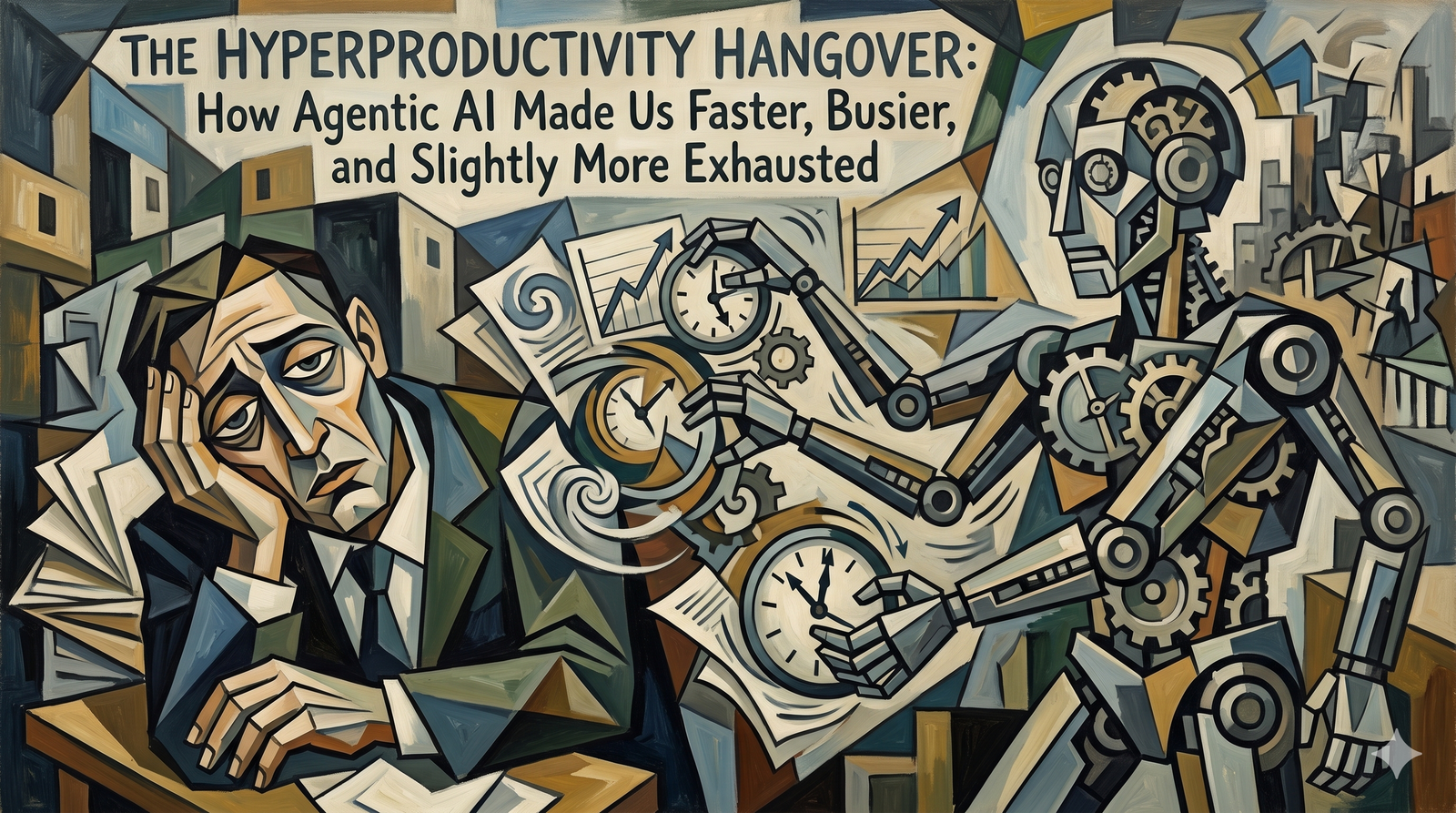
(Or: be careful what you wish for. You might actually get it.)
TL;DR
The data is in, and it is doing three things at once. Yes, agentic AI is making knowledge workers measurably more productive. Studies consistently report 10 to 50 percent task-time reductions, and 75 percent of global knowledge workers now use AI tools regularly. And also: those same workers are putting in more hours, fielding more interruptions, fitting in more out-of-hours work, and reporting record levels of mental fatigue. And, more quietly, the early neuroscience suggests we're also thinking measurably less when we lean on AI, with effects that linger even after we put the tools down. This isn't a paradox. It's a 160-year-old economic law (hi, Jevons) meeting some very new brain scans. The productivity gains are real. So is the bill. So is the brain. Pay attention to all three.
The promise we wished for
For about twenty years, knowledge workers have been quietly wishing for the same thing. Less admin. Fewer meetings. Faster turnarounds. More output with less effort. A computer that could just do the email for once. We made vision boards. We bought productivity books. We attended conferences with names like Future of Work.
And then, with surprising speed, the wish was granted.
AI would do the boring bits. We'd have more free time. Friday afternoons would be reclaimed. Inboxes would solve themselves. We would, finally, leave the office on time and develop hobbies.
Some of this is happening. Most of it isn't. The gap between those two facts is the most interesting story in knowledge work right now. And it's a useful reminder, in the very oldest sense: be careful what you wish for. You might actually get it.
The good news first
Let's start with the part that is, undeniably, real. AI is making people faster.
The numbers are surprisingly consistent. A landmark study of generative AI in a large call centre found productivity gains of 14 to 15 percent measured by cases resolved per hour. Across writing, customer support, software development, accounting, law, and translation, peer-reviewed studies report 15 to 50 percent reductions in task-completion time, with meaningful quality gains as well. Roughly 75 percent of global knowledge workers now use AI tools regularly.
At the macro level, self-reported time savings add up to about 1.6 percent of all US work hours, implying roughly a 1.3 percent labour productivity boost since ChatGPT's release. The most striking finding: quality gains concentrate among workers in the bottom half of the skill distribution. AI is lifting the floor faster than it's raising the ceiling.
If you'd shown these numbers to a productivity researcher in 2019, they would politely have called you optimistic. Wish granted.
And now, the bit nobody mentioned
Here is what happens at the same time.
Developers using AI tools showed a 19.6 percent rise in out-of-hours commits, meaning they're pushing code outside their normal working hours. An eight-month study of 200 workers at a US tech company found that, after AI was introduced, the same workers ended up working longer hours, at a faster pace, on a broader range of tasks. The length of the average focused, uninterrupted work session has dropped by 9 percent. Focused work hours overall have fallen a further 2 percent.
77 percent of employees say AI tools have added to their workload. A recent NBER study found that workers in AI-exposed occupations now put in roughly three extra hours per week, and that leisure time has fallen by the same amount.
Engineers in particular are stuck in a strange new bottleneck. AI lets them generate three times more code. But somebody still has to review three times more code. Output expanded; the gating function didn't.
And the burnout numbers are climbing. Deloitte's 2025 Workforce Intelligence Report found that mental fatigue and cognitive strain have now overtaken sheer workload volume as the leading predictor of burnout. Translation: people aren't snapping because they have more to do. They're snapping because what they have to do is now harder, faster, and more cognitively demanding.
Jevons enters the chat
There's a name for what's happening. It's an old one.
In 1865, the English economist William Stanley Jevons made an observation about the steam engine. As engines became more efficient, England did not, as one might expect, use less coal. It used more. The cheaper coal became to consume per unit of work, the more uses people found for it. Efficiency created demand.
This is now a well-known principle in economics: the Jevons paradox. And it is, as of roughly 2024, the operating system of knowledge work.
When AI makes writing faster, teams write more. More blog posts. More emails. More documentation. More variants. When AI makes data analysis faster, stakeholders request more analyses. When AI makes image creation faster, design teams produce more options for review. When AI makes anything cheaper to do, the appetite for that thing expands to fill the new capacity, and then some.
The net effect isn't that you do the same work with less effort. The net effect is that the definition of enough silently moves. If AI makes you 10x more productive, the world doesn't give you 10x more rest. It gives you 10x more to do.
The infinite workday
Microsoft's 2025 Work Trend Index put some uncomfortable numbers on the felt experience.
Workers using Microsoft 365 are now interrupted, on average, every two minutes during core hours. That's around 275 interruptions a day. Communication (email, chat, meetings) consumes 60 percent of the average workday, leaving only 40 percent for actual creative work, including the work AI is supposedly accelerating.
48 percent of employees, and 52 percent of leaders, say their work feels chaotic and fragmented. One in three says the pace of work over the last five years has become impossible to keep up with. According to Fortune's reporting on the underlying data, average time spent on email has doubled.
The picture is unmistakable. AI didn't slow the chaos down. It sped up everything around the chaos. The chaos, predictably, got more chaotic.
And while we're at it, the brain bit
Here's the part that doesn't show up on the productivity dashboard.
In June 2025, MIT's Media Lab put 54 people in front of an SAT essay task. One group used ChatGPT. One used Google. One used nothing. EEGs recorded brain activity across 32 regions of their skulls. The findings, in academic language, were that the ChatGPT group "consistently underperformed at neural, linguistic, and behavioral levels." In plain English: the people using AI were thinking less. Up to 55 percent less, by some of the engagement measures.
Worse, the cognitive sluggishness didn't switch off when the AI did. Even after participants stopped using ChatGPT, their brain activity was still measurably reduced compared to the no-tool group. The model went away. The dampened thinking stayed.
A separate study by Microsoft Research and Carnegie Mellon, presented at CHI 2025, surveyed 319 knowledge workers and analysed nearly 1,000 real-world AI-assisted tasks. The finding was almost the opposite of intuitive. The more workers trusted AI, the less critical thinking they did. People with high self-confidence kept thinking; people with high AI-confidence stopped. Trust, in this domain, turns out to be expensive.
Researchers are now using a phrase for this: digital cognitive atrophy. The same instinct that means we no longer remember phone numbers (because our phones do) is now extending into writing, analysis, judgment, and decision-making. The 666-person Gerlich study found that frequent AI use correlated significantly with weaker critical thinking, mediated by cognitive offloading. One line from the research is gently devastating: older workers offloaded tasks they already knew how to do; younger workers offloaded tasks they never learned how to do in the first place.
So here is the third bill that's quietly arriving. We are getting more done. We are also, on the available evidence, doing it with measurably less of our brains switched on. Productivity went up. Cognition went down. Both, it turns out, count.
This isn't a doom message. AI calculators didn't ruin mathematics; they did, however, ruin our mental arithmetic. The same thing is now happening to our writing, our reasoning, and the small everyday workouts that used to keep our judgment in shape. Worth knowing. Worth designing against.
So what do we actually do about it
Two things, mostly.
First, recognise the trap. The productivity gains are real, but the savings, if you do nothing, will not accrue to you. They will accrue to whoever sets the expectations. The bar will move. Quietly. Without warning. The only way to capture some of the upside personally is to set ceilings on output before someone else sets floors on it.
Second, redesign the rhythm. AI is genuinely good at compressing the work, but compressed work is not the same as good work. Deep thinking still requires uninterrupted blocks. Strategic decisions still require slack. If you spend the productivity dividend entirely on doing more, you'll end up with more work and worse decisions. That's the hyperproductivity hangover in a sentence.
Third, keep using your own brain on purpose. Pick the things you want to stay sharp at (writing, reasoning, judgment, your own opinions) and do them by hand sometimes. Not because AI can't help. Because, like a muscle, the thing you stop using will quietly stop working. The neuroscience is uncomfortably clear on this, and pretending otherwise would, ironically, be the kind of unthought-through move the studies are warning about.
Done well, agentic AI gives you the option to do the same work in less time and use the rest for something else (rest, thinking, depth, a side project, your kids, your hobbies, the long-promised Friday afternoon). Done poorly, it turns you into a faster cog in a noisier machine.
The technology does not pick which version you end up with. You do. And so, increasingly, do the people setting your KPIs.
The productivity gains are real. The bill is also real. Pay attention to both.
We wished for a faster horse. The universe, ever literal, gave us a faster horse. The fact that the horse has not stopped running is, technically, on us.
Sources
- AI Productivity Statistics 2025, Worklytics
- The Impact of Generative AI on Work Productivity, St. Louis Fed
- Why developers using AI are working longer hours, Scientific American
- AI isn't making work easier, it's intensifying it, IT Pro
- Microsoft 2025 Work Trend Index: Breaking down the infinite workday
- AI promised supreme productivity but is straining workloads, Fortune
- The AI Productivity Paradox: Why Efficiency Makes Us Work More
- The cognitive crunch: Why AI is accelerating burnout, HR Executive
- Your Brain on ChatGPT, MIT Media Lab
- The Impact of Generative AI on Critical Thinking, Microsoft Research and Carnegie Mellon (CHI 2025)
- AI Tools in Society: Impacts on Cognitive Offloading and the Future of Critical Thinking, Gerlich (MDPI)
- AI tools may weaken critical thinking skills by encouraging cognitive offloading, PsyPost