
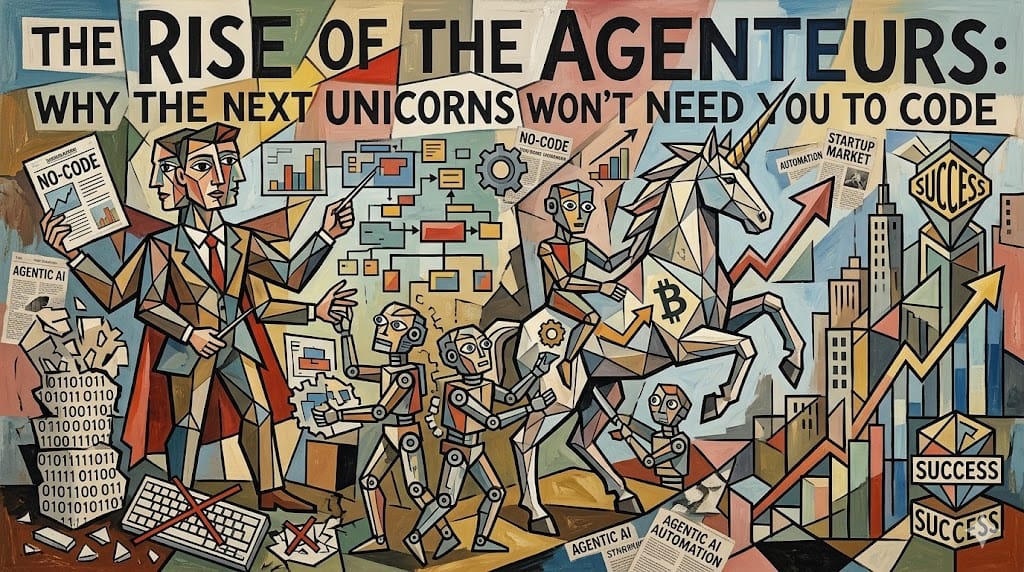
(Or: how the best idea in the room finally wins, even if the room contains one person and a laptop.)
TL;DR
Something quietly enormous is happening to entrepreneurship. Agentic AI (think: software that doesn't just answer you, but actually goes off and does the thing) is collapsing the cost, the time, and the team size required to build a real company. The era where you needed a co-founder who could code, a seed round to "build the product," and eighteen months of runway just to get to a demo is, with surprising speed, ending. In its place is a new figure: the Agenteur. Not a techie. Not a non-techie. Someone who's exceptionally good at deploying AI agents to turn ideas into products, customers, and revenue. The first one-person unicorns are already showing up. The build-test-learn cycle has collapsed from years to weeks, which means founders now fail (or succeed) faster than the old VC machine can even schedule a follow-up meeting. The case for taking early-stage venture capital has shrunk with it; for most software founders, the seed round is now closer to a tax on speed than a fuel for it. This is a 1995-internet-sized moment, and the people who win it will be the ones with the best ideas and the cleanest agent stack, not the biggest cap table.
The old story (rest in peace)
For roughly thirty years, the startup story went like this. You had an idea. You needed a technical co-founder. You probably needed a seed round, then a Series A. You hired engineers. You built an MVP. You spent twelve to eighteen months getting to "does this work at all," at which point you raised more money to find out if anyone actually wanted it.
The whole engine was built around one assumption: building software is hard and expensive. Investors existed because building software was hard and expensive. Co-founders existed because building software was hard and expensive. Two thirds of every startup pitch deck existed because building software was hard and expensive.
That assumption is, in 2026, no longer true. The implications are quite large.
What actually changed
There's been a lot of breathless writing about AI. Most of it has missed the part that matters for entrepreneurs. The interesting shift isn't that AI can write a paragraph or generate a picture of a horse. It's that AI can now do jobs.
An agent can build the website. An agent can run the customer support inbox. An agent can write the marketing copy, set up the ad campaigns, watch the metrics, and adjust the campaigns the next morning. An agent can do bookkeeping. An agent can read every contract, every receipt, every email, and produce a coherent summary by Tuesday.
Stack enough of these together and you have something that used to be called "a small team." Except this small team works around the clock, doesn't get sick, doesn't ask for equity, and costs roughly the price of a Netflix subscription per agent per month.
This is the bit that's properly different. The agents aren't replacing engineers in the abstract. They're replacing the whole apparatus you used to need to turn a good idea into a working business.
The one-person unicorn was a meme. Then it wasn't.
A few years ago, Sam Altman floated the idea of a one-person billion-dollar company. At the time, it sounded charmingly mad. Most people put it next to "self-driving cars next year" on the list of things to politely nod at.
It's no longer mad. There are now solo founders running businesses with millions of users, eight-figure revenue, and a single human on the payroll. Their secret is not that they are 200 times better than other founders. Their secret is that they have figured out how to orchestrate agents to do the work that 199 other people used to do.
These are early data points, not yet a trend you can write a textbook about. But the direction of travel is impossible to miss. The number of people required to build something genuinely valuable is collapsing, and it's collapsing fast.
The cycle is days, not years
The other thing nobody is fully reckoning with: the speed of building has changed underneath us.
The old loop was twelve to eighteen months. Idea, plan, fundraise, hire, build, launch, finally find out if anyone actually wants the thing. By the time you had your answer, you'd burned a year, half a seed round, and most of the goodwill of the people you'd convinced to join.
The new loop is closer to two weeks. Idea on Monday. Agents pointed at it by Tuesday. A working prototype by Thursday. Ten customer conversations by the following Friday. A verdict shortly after.
This is the bit that's quietly transformative. It's not just that you can build cheaper; it's that you can learn faster. Every week is a complete cycle. Every cycle teaches you something concrete. The best Agenteurs aren't smarter than everyone else; they've just compressed the feedback loop so tightly that they get to be wrong ten times in the time it used to take to be wrong once.
Failure, in this world, is no longer expensive. It is, oddly, useful. You try something, it flops, you've lost a fortnight and a few hundred quid, and you've learned a real lesson. Move on. Most great companies of the next decade will be the third, fifth, or eighth idea of their founders, not the first.
And success, when it shows up, compounds at the same pace. The agents that helped you find the idea will help you grow it, support it, scale it. The team is already running.
Why you can (and probably should) skip the seed round
Once you've internalised the new cycle, the case for early-stage venture capital starts to wobble badly.
Early-stage VC exists because building software used to be expensive. That is, more or less, the entire founding premise of the industry. You needed capital because you needed engineers, designers, ops, marketing, and twelve months of runway to put them all in a room. The seed round was the price of admission to even attempt to build something.
Take an honest look at what that capital actually buys today. Engineers? Agents write the code. Designers? Agents design. Marketing? Agents run the campaigns. Customer support? You guessed it. The single biggest line item on most early-stage burn rates was payroll for jobs that, in 2026, cost the price of a few API subscriptions per month.
What's left is the soft stuff: introductions, mentorship, signalling, someone to call when things break. These are real, but they're also wildly oversold. Most early-stage VCs have less operational experience than the founder they're funding. Most intros are to other portfolio companies. "Signal" matters until you have customers, at which point customers are the signal.
Now look at the price. Twenty to twenty-five percent of your company, in perpetuity, for capital you didn't need. Quarterly board theatre. The relentless push to grow at venture pace, which is the wrong pace for most businesses. An exit math problem where selling for $30 million is treated as a failure, even though it would change your life. And three to six months of every couple of years spent fundraising instead of building.
The trade used to be obvious. It isn't anymore. For most software founders in the agentic era, taking early-stage VC is closer to a tax than a tool. You are voluntarily handing a quarter of your company to a stranger so they can encourage you to make decisions you didn't actually want to make.
There are exceptions. Capital-intensive businesses (hardware, biotech, regulated infrastructure) still need it. Genuine winner-take-all races with brutal timing still need it. But for the long, growing tail of solo and small-team AI-native companies, the default has flipped. The question is no longer "when do I raise." It's "what would I even spend it on."
The best Agenteurs already know this. They keep their cap table clean. They put revenue first. They use AI to do the work that headcount used to do. And when they need money, they raise it from customers, not investors.
The skill that matters now isn't coding
Here is the slightly uncomfortable truth for everyone who spent the last decade learning to code: the differentiator is no longer the ability to write the code. The agents will write the code. The differentiator is everything around the code. Knowing what to build. Knowing who to build it for. Knowing which agent to point at which problem. Knowing how to chain three of them together so the output of one feeds the input of the next, and the whole thing runs while you sleep.
This is a real skill. It is also, refreshingly, not a technical skill in the traditional sense. It's closer to good management, good taste, and a willingness to roll your sleeves up and try things.
Which means the next generation of founders won't necessarily come from computer science departments. They'll come from anywhere. Marketers. Operators. Designers. Domain experts. Teachers. People who spent ten years in an industry and know exactly where the painful, expensive, unsolved problems are. People who, until very recently, had brilliant ideas and absolutely no way to build them.
Introducing: the Agenteur
We need a word for this, because "non-technical founder who's really good with AI" doesn't fit on a business card.
Let's call them Agenteurs.
The word is half agent, half entrepreneur, which is roughly the right blend. The -eur ending is the same one that gives us entrepreneur and auteur: the doer, the maker, the one who actually goes out and does the thing. An entrepreneur builds a company by orchestrating people, capital, and time. An Agenteur builds a company by orchestrating agents, capital, and time. Same instinct. Same hunger. New toolkit.
An Agenteur isn't a techie. An Agenteur doesn't necessarily write code. An Agenteur is fluent in the operating model of modern AI: which agents are good at what, how to brief them properly, how to wire them together, how to spot when one is hallucinating its way through your week, how to step back and let the system run.
If the 1990s belonged to the techies, who could code their way through the internet, the late 2020s belong to the Agenteurs, who can orchestrate their way through the AI era. Different sport. Different skill. Same energy.
Why this is a 1995 moment
It's worth being honest about how big this is. We've had two similar shifts in the last thirty years.
The internet, around 1995, suddenly made distribution free. Anyone could publish to the world. Anyone could sell to anyone. The companies that won were the ones that understood the new physics of distribution earlier than everyone else.
Mobile, around 2008, suddenly made software personal. Anyone could be reached anywhere. The companies that won were the ones that understood the new physics of context earlier than everyone else.
Agentic AI, right now, is suddenly making production free. Anyone can build. Anyone can run an operation. The companies that win this one will be the ones that understand the new physics of leverage earlier than everyone else.
This is the same kind of moment. It feels a bit chaotic. It feels a bit too fast. People are quietly building things in the corner that, in 18 months, will look obvious in hindsight and unreachable in present tense.
What to do about it
If you're sitting on an idea you've been quietly nursing for years, the answer is no longer "I can't, I don't know how to code." The answer is "let's see what an agent can do with this by next Friday."
If you're already running a business, the question to ask is not "how do I add AI features." It's "which parts of my company would actually run better if a fleet of agents was doing them, and how soon can I find out."
And if you're early in your career, the most underrated skill you can build right now is the one nobody's degree teaches: getting agents to do useful, reliable, repeatable work. This is the new literacy. It is, for the next few years at least, also the new arbitrage.
The barrier to building has fallen through the floor. The best ideas have always wanted to win. Now, finally, they can.
The entrepreneur built the last century. The Agenteur is about to build the next one. The room is wide open. Bring a laptop.